It’s the world’s best known and, these days, its most popular museum. You could tell that by the queue. It snaked, zig-zag fashion, from a tent inside the vast forecourt to outside in the street. There were no special attractions, just the usual broad ranging fascinating stuff. Less than one percent of their hoard is on display which I find a bit selfish. I’ve never understood why some country, like Australia perhaps, doesn’t put up a building and have some of their 99% others on display.
I dwelt on that as I waited patiently. Also, the Standard of Ur was bugging me. I’d seen it over a decade ago but it had been incorrectly labelled so I emailed the museum (as instructed) but no reply was ever forthcoming.
Today I hoped for better luck, bearing in mind that, although less than one percent is ever on show, some top attractions are almost always there.

Somehow I remained calm during the wait, moving slowly along with the hundreds of others. Rain, hail or shine we come to view the treasures therein and there’s a wonderful sense of anticipation as you walk up the stairs through the Ionic columned portals knowing that some of the great treasures of antiquity will soon be before you although most people pass through without realizing that a small but significant percentage of what’s on show are copies.
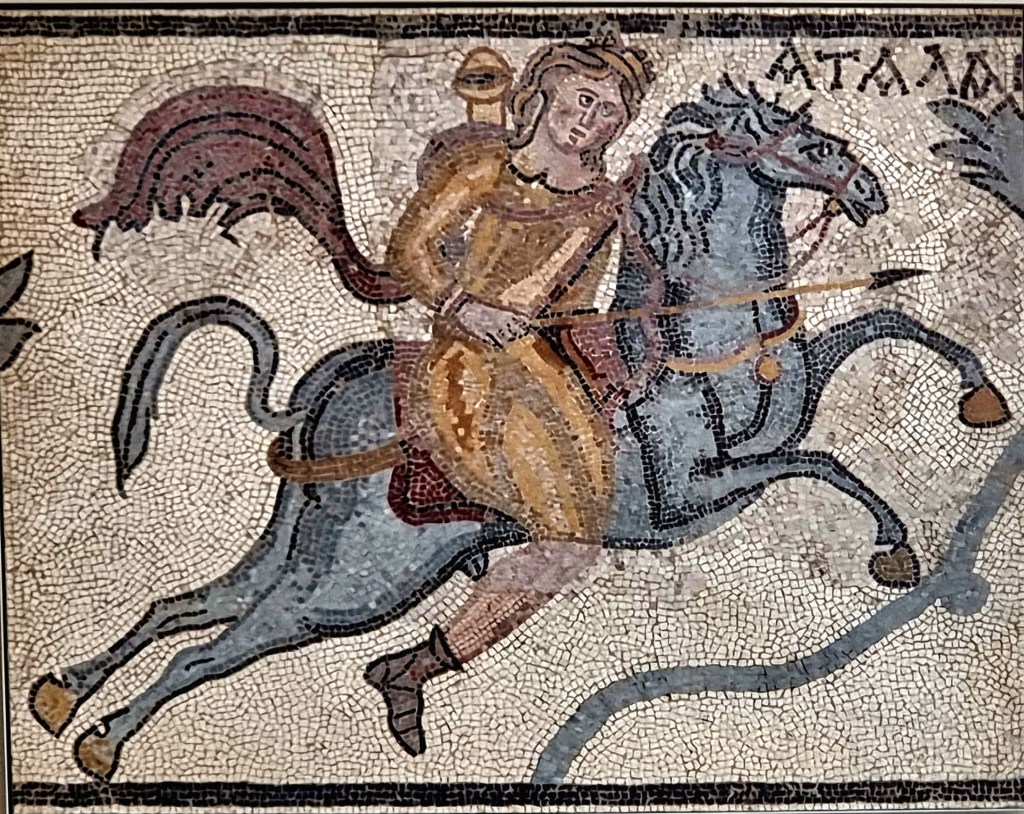
Beneath the glass dome that sheds light everywhere I opt to head up a staircase bedecked with attractive Roman mosaics on the walls; some even from Ephesus in Turkey where I’ve visited twice because it’s such a wonderful site and had the third largest library of the ancient world.
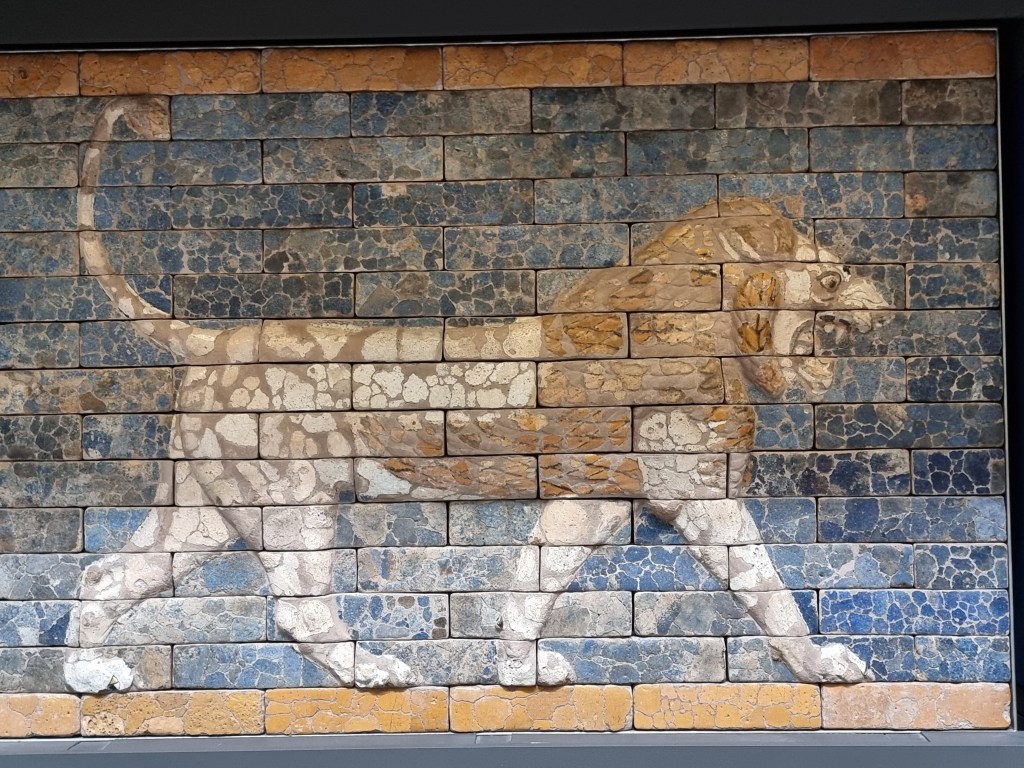
Then it’s out among the crowd and there are thousands inside, making it difficult to see some of the displays so I opt for the less packed Mesopotamia section where there’s a glazed lion from the throne room of the fabled King Nebuchadnezzar II of Babylon. It’s one of many of his building projects designed to make Babylon one of the most impressive of the ancient world. A museum in Berlin has the complete Ishtar Gate which has its walls lined with these lions which represent Nebuchadnezzar.
Mesopotamia, a Greek name meaning “land between the rivers”, as in Tigris and Euphrates, was at its height between 1500-500 B.C. and has been imagined as an area for the cradle of civilization. More recent discoveries and dating have made all that old hat. One city in Turkey goes back 11,000 years and other ruins have been discovered going back 12,000 years!
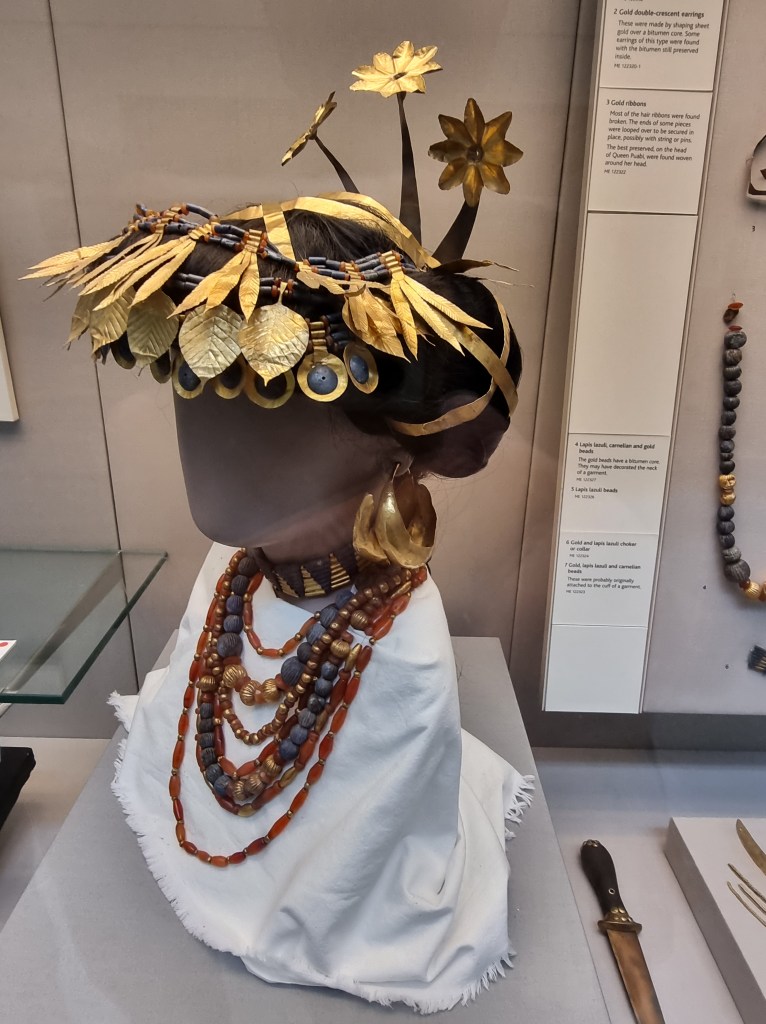
Then, nearby, it’s the Great Death Pit with the Standard of Ur, Ur being one of the great cities of antiquity in southern Iraq. Amongst the treasures within were the bodies of six guards with their weapons and 68 women which came from the Ubaid period, somewhere between 6000-4000 B.C., depending on which site you view. The jewellery and accoutrements of gold and lapis lazuli have been painstakingly restored on a dummy head in an impressive showing of what was available over 6,000 years ago.

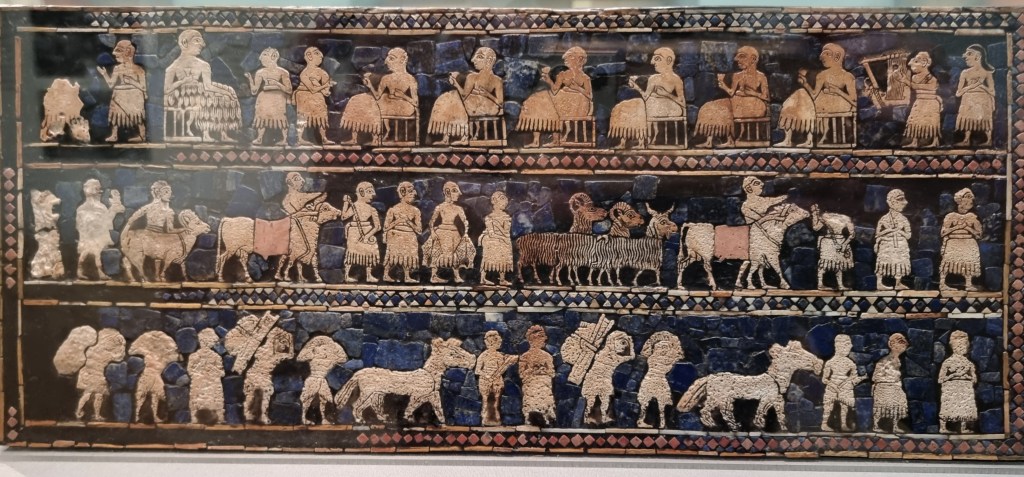
Then, the Standard of Ur, at last, so named because it had been carried on a man’s shoulder like a battle standard but its exact use is unknown. Mosaic scenes done with incised shell, red limestone and lapis lazuli were set in bitumen. War, peace, prosperity and banquet scenes are all depicted in this wonderfully restored treasure that had to be totally redone because the wood it had been set on had basically disintegrated. I finally got to absorb it.
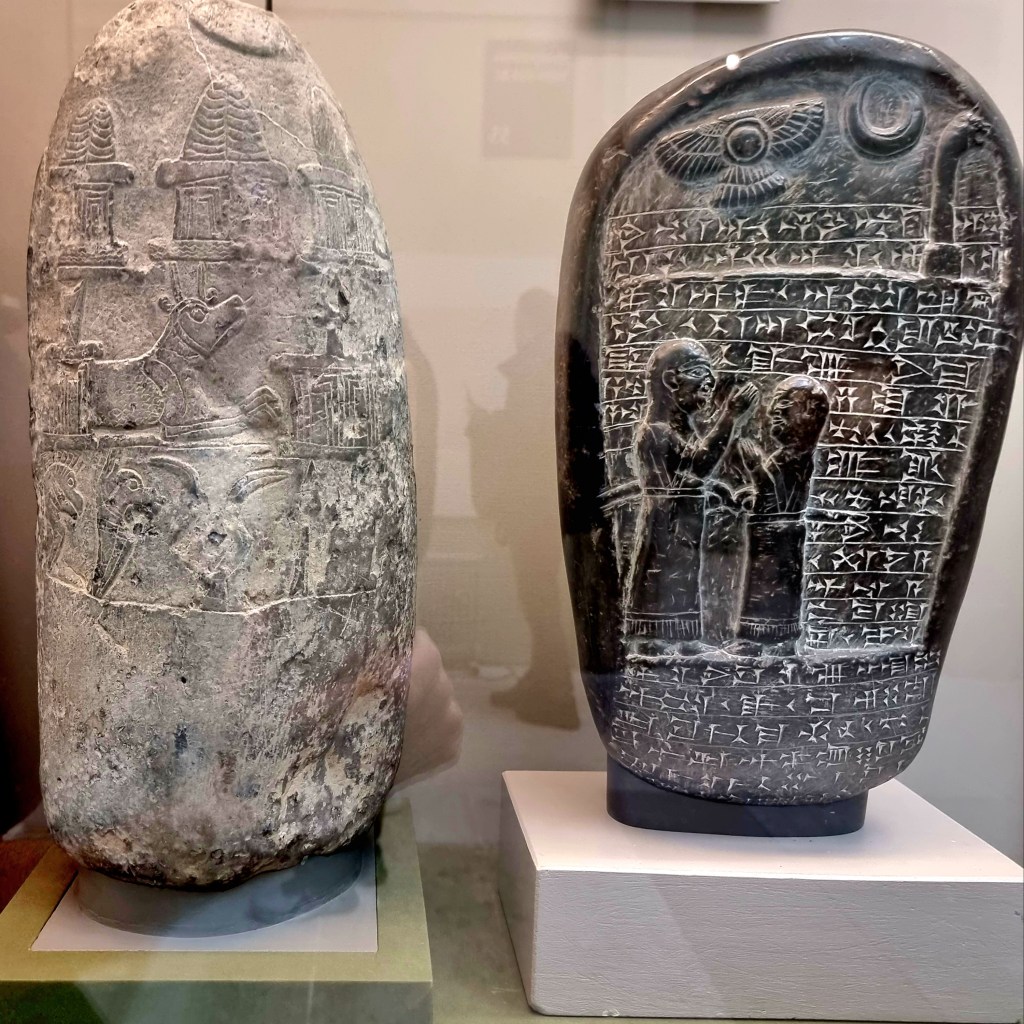
Nearby, Babylonian boundary stones (kudurru) intrigue me. They record the military service of Ritti-Marduk, a chariot commander who now enjoys tax exemptions and is free from legal obligations! Must get one of those.

Speaking of Babylon, is there a more valuable piece than the Cyrus Cylinder? It’s a clay cylindrical shaped work that has the conquest of Babylon by Cyrus in 539 B.C. written on it in cuneiform, clearly extolling his virtues in somewhat narcissistic tones, and was designed to be buried beneath the city walls. It’s the information that it contains, rather than any material wealth or such that gives it pride of place.
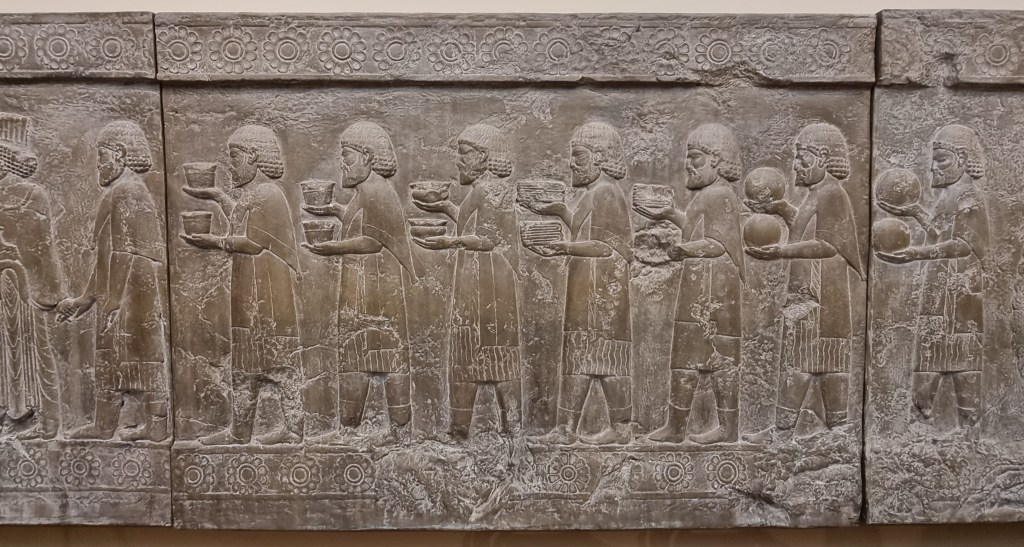

Persepolis, 518-339 B.C., in Iran (from the Greek meaning “Persian City”) is another classic place, started by Darius and elaborated on by Xerxes and Artaxerxes before being trashed by Alexander the Great (so-called in English culture) who is not viewed by Turks and others as such because he destroyed so much. The museum contains an amazing cast copy of the Apadana, a monumental columned receiving hall inside the palace showing all manner of people representing states bringing goods and offerings to the rulers.


Next I’m into the famous hoards that periodically seem to get unearthed in Great Britain. Sutton Hoo is the most famed. Dating back to A.D. 600 it appears to have been a royal burial in a 27 metre long ship and, though the boat disintegrated in the acidic soil, a helmet and other goods, too numerous to mention here, survived. They’ve also done a complete recreation of one of the head pieces and it’s noted that a lot of the other goods came from the Byzantine area of the Mediterranean, especially all the silverware. Also, there are no horns on Viking helmets, there never were. However, somewhere on their attire was a belt buckle, a stunning 400 gram work of Frankish design.

The head piece is matched by an amazing Roman bronze face mask visor helmet from the Ribchester Hoard, unearthed in 1796 by a child playing in his father’s backyard. The mere concept of such a thing beggars belief, let alone wearing it! Not recommended in summer.
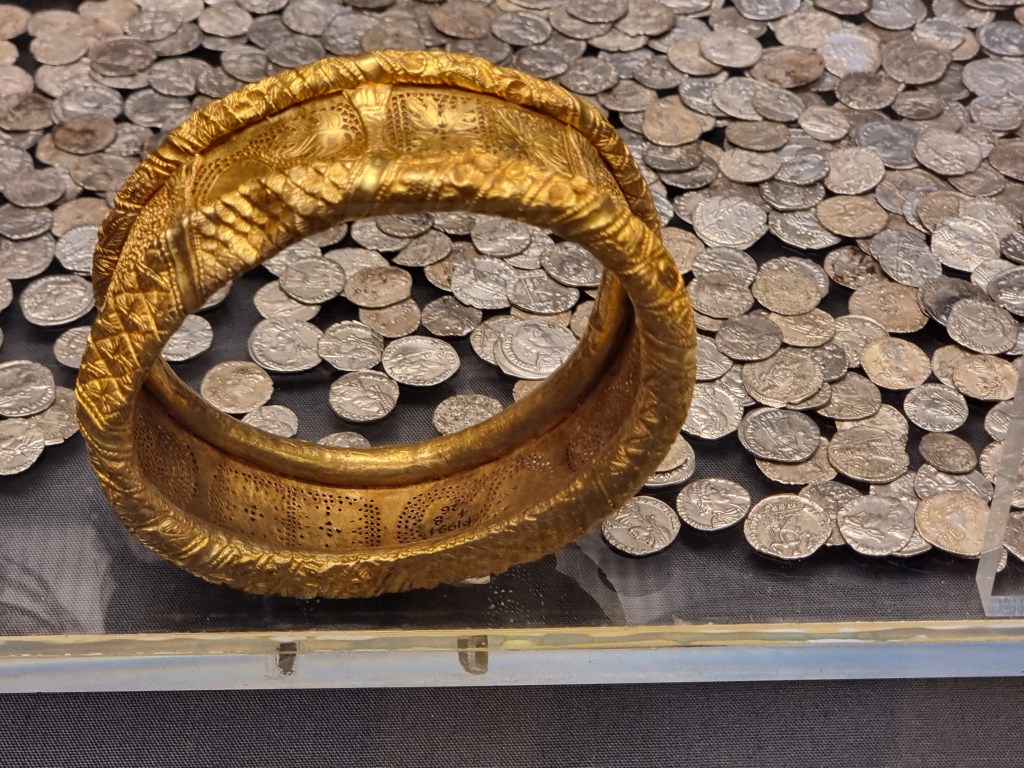
However, it’s the Hoxne Hoard, only unearthed in 1992, that takes my attention. Over 15,000 silver coins, gold coins and jewellery and lots of silver tableware were carefully extracted after the finder of the hoard, Eric Lawes, notified archeologists and authorities. How did he come to locate the largest hoard ever found? He was looking for a lost hammer of course! He received 1.75 million pounds from the government which he shared with the land owner.
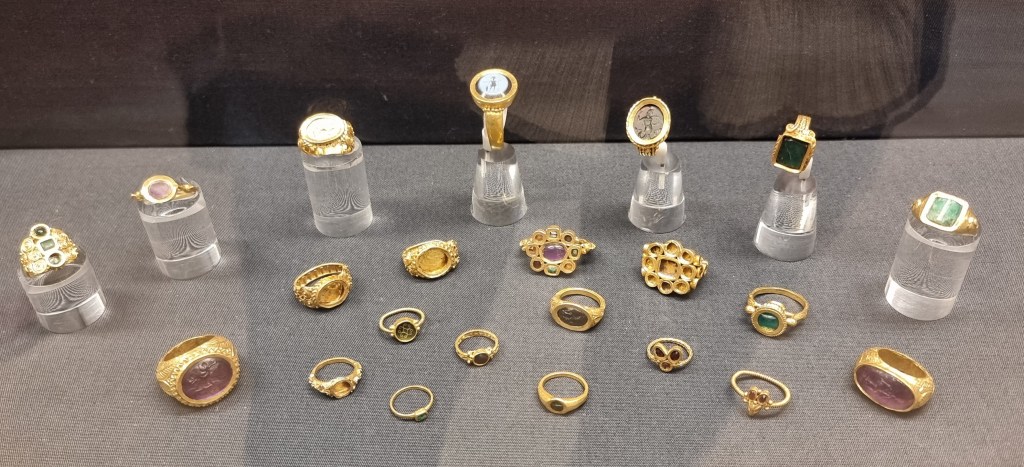
The Thetford Treasure, with its 22 stylish and complex designed finger rings, next competes for my attention. The array of complex Roman designs is wondrous to behold, made even more interesting by the fact they only came to light in 1979.

Nearby I learn about torcs, a decidedly uncomfortable looking necklace that you wouldn’t want to have on for too long. Normally made of precious metals or bronze, just the thought of putting one on has me wincing. Imagine wrapping a 2kg piece of steel cable around your neck and you get the idea. The best one is made of electrum (no, I’d never heard of it either), a naturally occurring alloy of gold and silver. These date to approximately 100 B.C. and come from the Snettisham Treasure, some of which was only found in 1990.

Another small bundle of treasure comes from the Isle of Lewis where, in 1839, 78 chessmen and 14 game counters, carved from walrus ivory and whale tooth, were unearthed. You had to be careful carving the tusks as the second dentine, an unsightly substance, was to be avoided. Also, flakes of red paint indicate that black and white was not the original colour here.
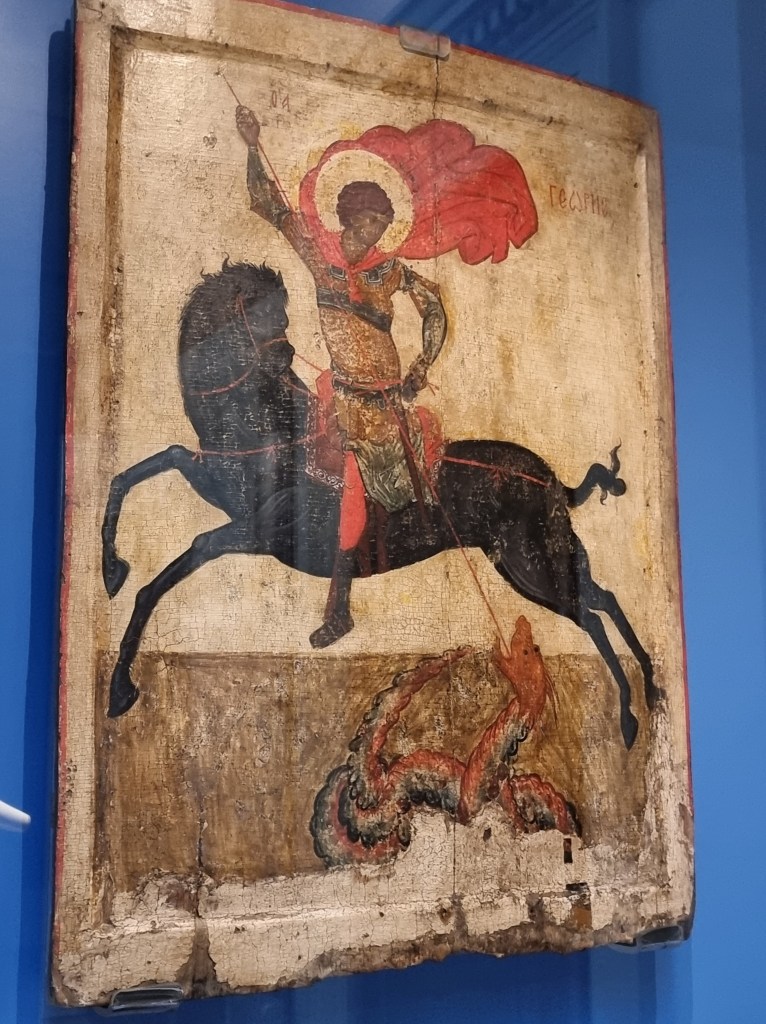
In 1959, in a village in Northern Russia, a painting called Black George was discovered being used as a window shutter. It dates back to the 1400’s; amazing it survived! It’s so unusual because St. George is almost always portrayed on a white steed.
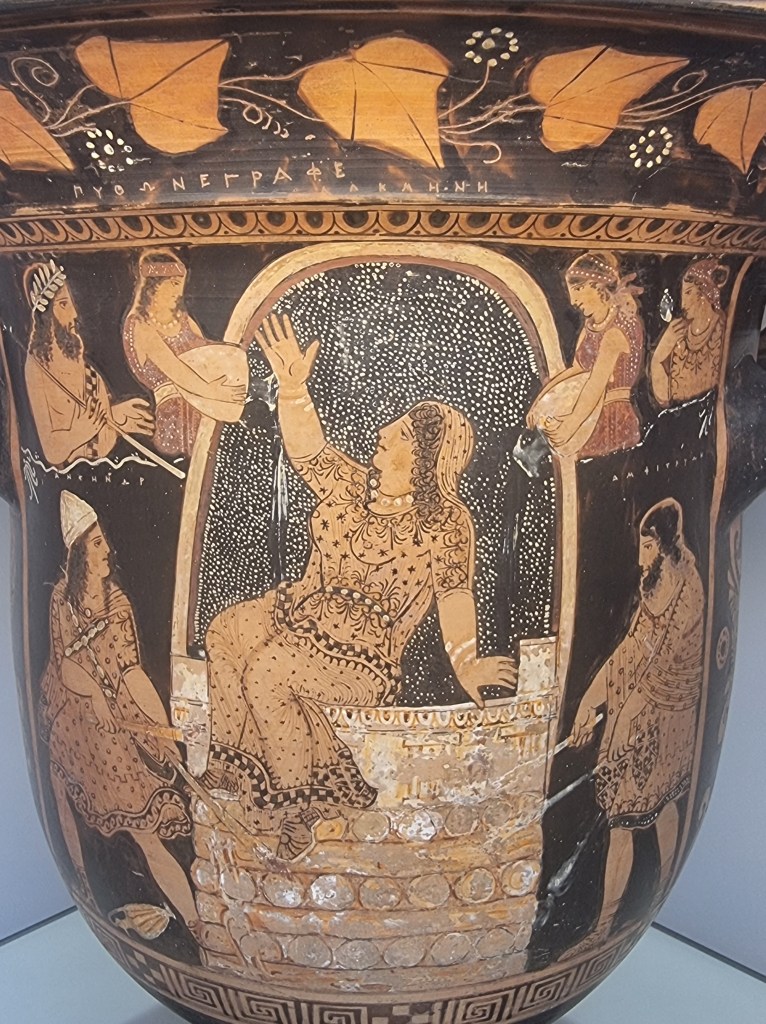
In a section labelled “Greeks in Italy” I come across a bell-krater (wine bowl) that features Alkmena, who I’d never heard of (and neither has spell check), granddaughter of Perseus and Andromeda and married to Amphitryon. Turns out that sex-crazed Zeus, who had it off with just about every female, disguised himself as her husband, made love with her and the result was the Greek hero Heracles. This displeased her husband somewhat and he tried to set her on fire (the part shown in the wine bowl) before she called on Zeus who sent the clouds over to drop some rain on the whole scene.
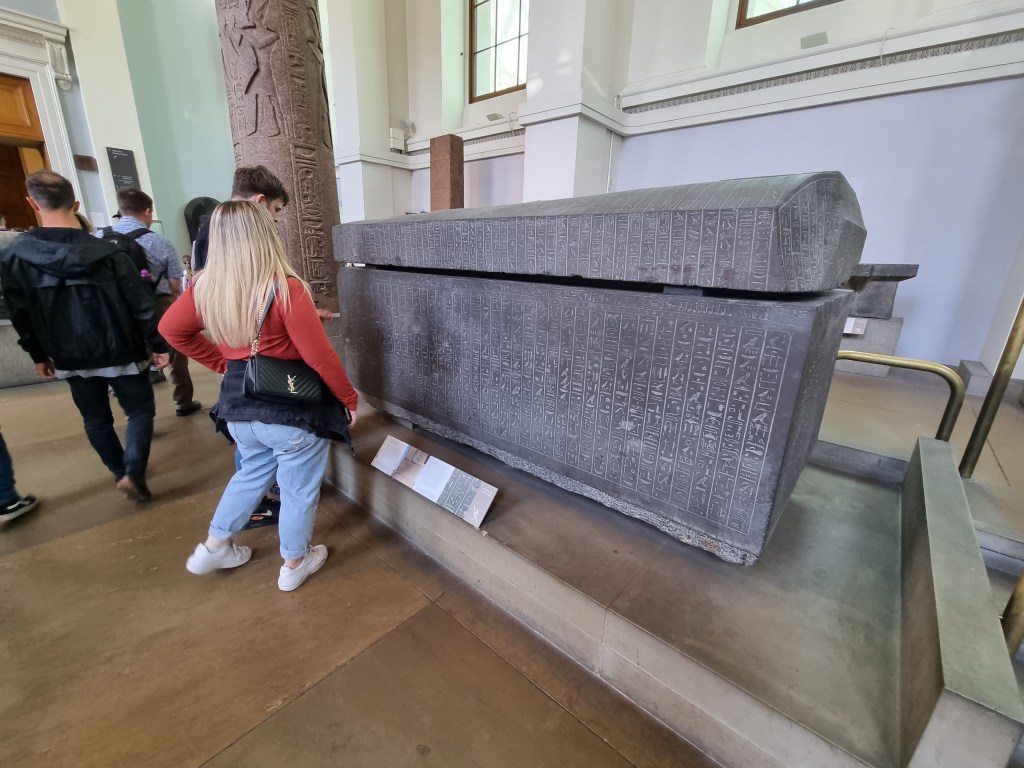
Apparently there’s a bit of archaeological stuff from a place called Egypt. I mean the sarcophagus inscribed with hieroglyphs (Greek for “sacred words”) was almost as big as the late occupant’s name – Ankhnesneferibre. You’re allowed to take a breath after you pronounce that. She was the last of the princesses installed in Thebes to curb the power of the priests and held sway as the “God’s wife of Amun”. However, all that became irrelevant when the Persians arrived around 500 or so B.C.

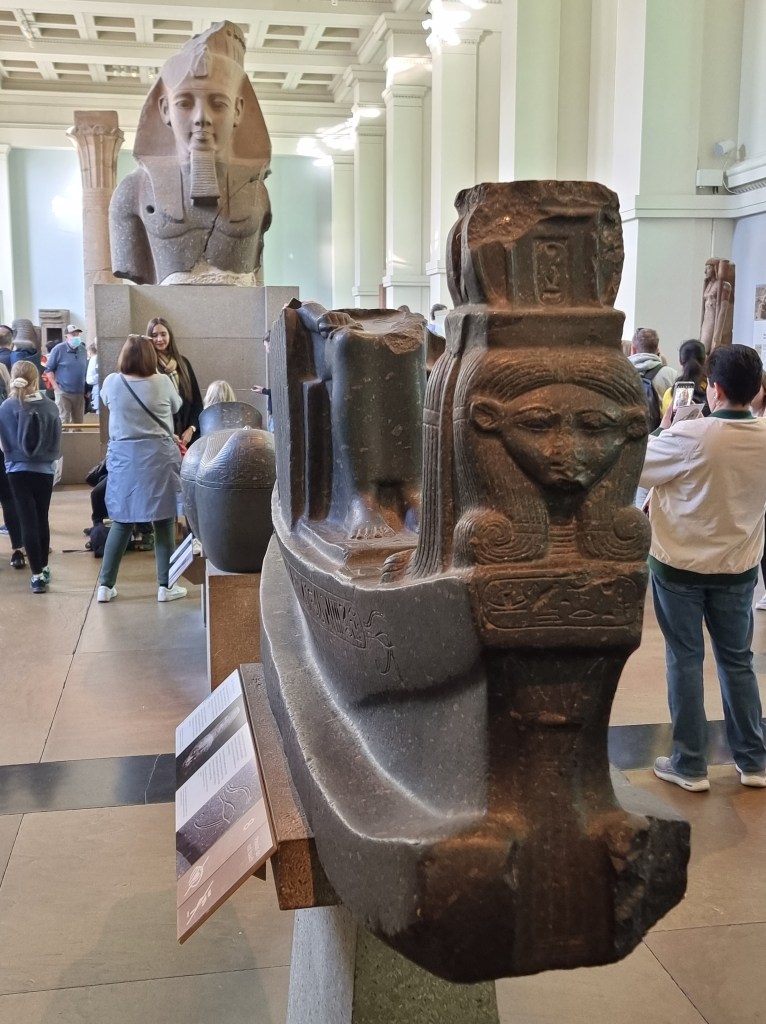
Of course, there’s an assortment of painted coffins and the huge statue (what’s left of it) of Rameses II set behind a solid granodiorite stone boat of Queen Mutemwia, wife of Thutmose IV and mother of Amenhotep III . Carved from a single block at Aswan and weighing 20 tonnes, Ramses II was transported over 200 kms to the site where it was installed and it’s just one of many organized by Rameses II, responsible for more colossal statues than any other pharaoh.

In the end, the piece I admired most was the Lycurgus Cup, a truly classic piece of art from the breathtaking Waddesdon collection of the fabulously wealthy Rothschilds. It depicts Lycurgus, king of Thrace, in dire trouble after attacking Dionysus, god of wine (shame on him!), his female followers and Ambrosia the nymph, who then pleaded to Mother Earth to transform her into a vine, which is what’s happening at the moment as Lycurgus is wrapped up and Dionysus, Pan and a satyr torment him. It’s simply exquisite.
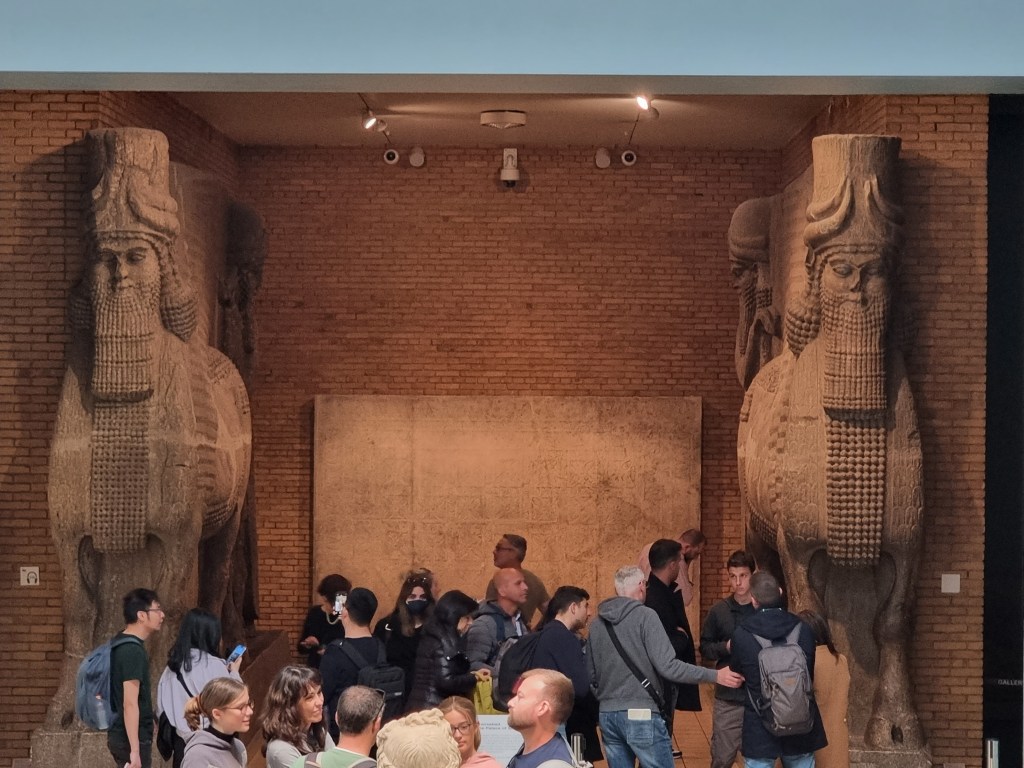
On the way out, like them or not, you can’t ignore the human headed winged bulls from the Assyrian Palace of Sargon at Khorsabad, dated before 700 B.C. People tend to gather here as the “in your face” nature of the exhibit makes a good, easy to find, meeting place and it’s an exhibit that you never forget. Bit like the museum really.
 Taking You To Places You've Never Been
Wow I don’t ever recall there being a line to get in back when I lived in London 20 years ago. As a poor broke backpacker this place was my go to for cold rainy days on the cheap.
LikeLike